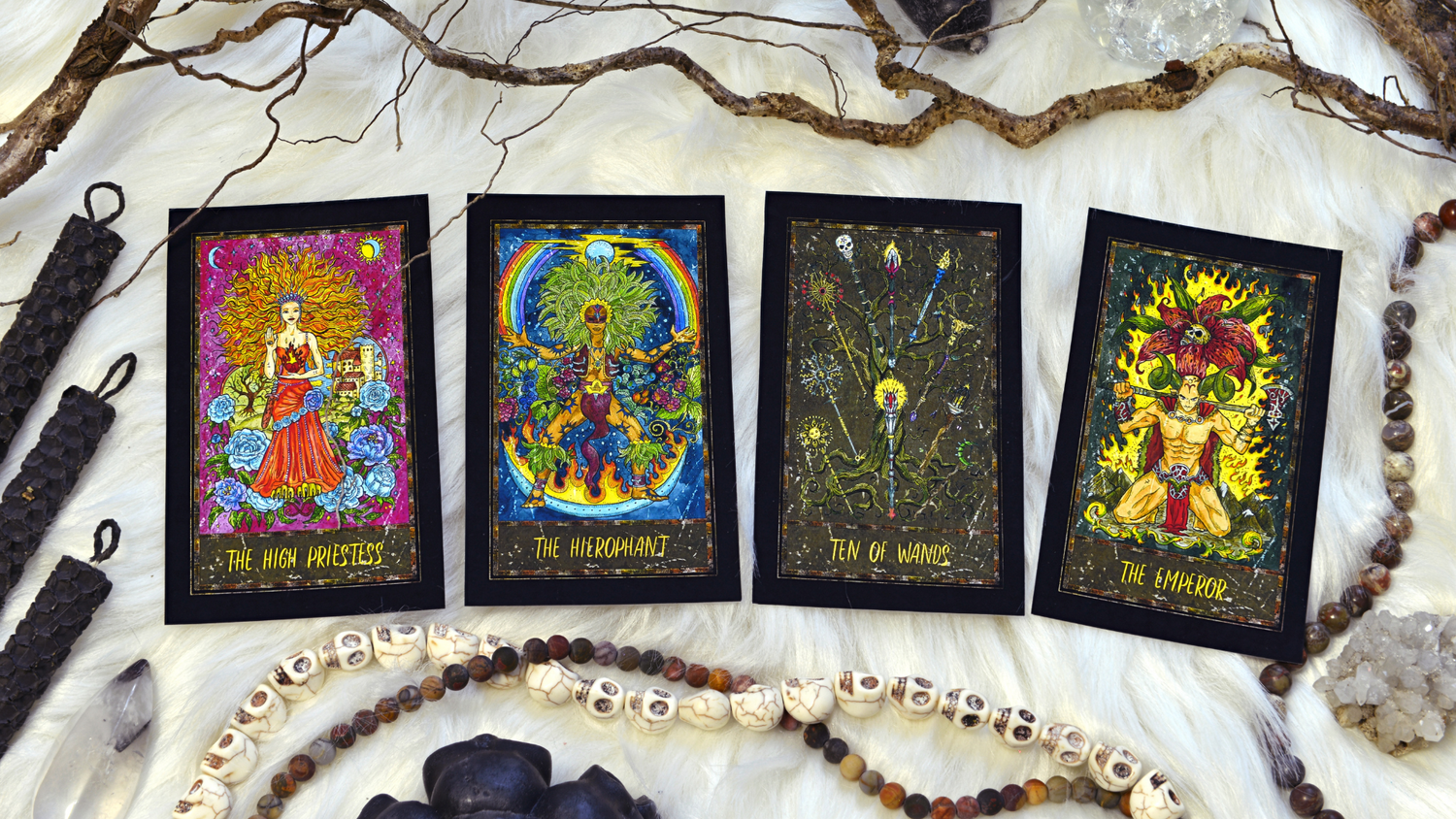


Why Tarot Spreads Matter
Spreads structure a reading. They define roles for each card, offering a narrative scaffolding that makes sense of individual images. A spread can be as simple as a one-card pull for daily guidance or as elaborate as a twelve-card, elementally-balanced layout used in ceremonial magic. Choosing the right spread helps the reader focus, provides clear prompts for interpretation, and supports outcomes that are practical, ethical and transformational.
What spreads do for a reading
- Clarify context: A spread sets the scope of the question and prevents vague readings.
- Define relationships: Positional meanings show how energy flows between different life areas.
- Structure timing: Some spreads include temporal positions (past, present, future) or lunar/seasonal alignment.
- Support ritual work: Spreads can be integrated into spellcraft, talisman creation and ceremonial practice.
How to Choose the Right Spread
Choosing a spread begins with the question. Ask yourself: what level of depth do I need? Is this a practical decision, an emotional inquiry, a yearly overview, or a ritual intention? The answer guides whether you use a short, tactical layout or a multi-card ceremonial spread.
Key considerations
- Question specificity: Specific questions do well with focused layouts (e.g. decision spreads). Open questions benefit from broader layouts (e.g. Celtic Cross).
- Time available: Longer spreads require more time to interpret thoroughly.
- Reader experience: Beginners may prefer 1–5 card spreads; intermediate and advanced readers can work with layered and conditional positions.
- Intentionality: If the reading is part of ritual, select a spread that allows for symbolic tools and activation steps.
Beginner Spreads: Build Confidence with Simple Layouts
Start with uncomplicated spreads that encourage consistent practice and journalling. Below are essential beginner layouts that develop interpretive skills without overwhelming detail.
1. One-Card Daily Draw
Cards: 1
Use: Daily focus, short guidance, or a quick check-in.
How to read: Note the first word or image that stands out, consider elemental correspondences, and reflect on how the card applies to your day. Record a one-sentence action based on the card.
2. Three-Card Spread (Classic)
Cards: 3
Common positions: Past — Present — Future; Situation — Challenge — Advice; Mind — Body — Spirit.
How to read: Read the three cards both individually and as a short story. Identify movement (Are the cards all of the same suit? Is there a recurring element?) and use that to offer practical next steps.
3. Choice/Decision Spread (4 cards)
Cards: 4
Positions: Option A (pros), Option B (pros), Hidden factor for A, Hidden factor for B.
How to read: Compare the two options side-by-side, paying attention to card suits and court cards to gauge potential energy and required action.
Intermediate Spreads: Deeper Context and Relationship Work
When you are ready to move beyond quick readings, intermediate spreads add nuance: relational dynamics, multi-layered outcomes and strategic guidance.
4. Celtic Cross | A Comprehensive Framework
Cards: 10 (standard positions).
Purpose: A full, nuanced reading for complex questions about personal or professional life.
Standard positions (short):
- Present situation
- Immediate challenge (crossing card)
- Subconscious / root
- Recent past
- Near future
- Conscious goal / aspiration
- Internal state / self-image
- External influences / environment
- Hopes/fears
- Outcome
How to read: The Celtic Cross requires careful synthesis, consider major arcana weight, suit distribution and whether court cards represent people, aspects of self, or qualities to adopt.
5. Relationship Spread (6–8 cards)
Example positions: You, Partner, Shared dynamic, Strength, Challenge, Advice, Future potential (optional), External influence (optional).
Tips: Use person-card interpretations conservatively; court cards are often symbolic of behaviour patterns rather than exact individuals.
6. Career & Project Spread (7 cards)
Suggested positions: Current role, Opportunity, Obstacle, Required skill/approach, Support available, Action step, Likely outcome. This spread is practical and lends itself to time-bound follow-up readings to measure progress.
Advanced Spreads: Ritual, Shadow Work and Year-Ahead Layouts
Advanced spreads integrate symbolism, ritual actions and multi-layered interpretation. They often require pre-ritual preparation, lunar timing, or collaborative readings within a coven or circle.
7. Shadow Work Spread (5–9 cards)
Example positions: Shadow trigger, Root cause, What is hidden, Integration path, Gift or lesson, Boundaries to set, Healing action (optional).
How to work: Shadow readings demand emotional hygiene: grounding before and after, protective rituals, and journalling. Use supportive crystals and a trusted friend or counselor if content becomes overwhelming.
8. Lunar/Ritual Spread (8–13 cards)
Design a spread aligned to a moon phase for ritual timing. Example positions for an 8-card lunar spread:
- Current lunar energy
- Intention to seed
- Obstacle to release
- Support/coven guidance
- Timing to act
- Symbolic action
- Outcome if aligned
- Blessing or closing step
This layout is ideal for integrating tarot into spellcraft: lay the cards on the altar, anoint a candle based on the core card, and follow tied ritual actions.
9. Year-Ahead Spread (12 cards or 13 with significator)
Option A (12 cards): One card per month, useful for seasonal planning and journalling prompts.
Option B (13 cards): Add a 'theme' card as the thirteenth card representing the year's overarching energy.
How to read: Consider each card both as an individual monthly theme and as part of a narrative arc. Note repetitions and progressions (e.g. recurring suits may show a dominant focus for the year).
Creating Your Own Spreads: Principles & Practice
Designing a custom spread is a creative act that benefits from clear structure. Follow these principles to create effective layouts that reflect your magical intent.
Principles for spread design
- Define purpose first: Each position must have a clear, concise prompt (e.g. 'block', 'inner voice', 'next step').
- Balance depth and usability: Avoid too many overlapping positions; the point of a spread is clarity.
- Use elemental symmetry: For balanced work, include positions representing Fire, Water, Air and Earth.
- Allow for ritual integrations: If the spread is for spellwork, reserve positions for actions, offerings or talisman charging.
- Test and refine: Use your spread several times, note ambiguities and revise positions until the layout yields consistently meaningful readings.
Practical method for designing a spread
- Write the intention in one sentence.
- Brainstorm the information needed to fulfil that intention.
- Assign each information item to a card position with a short label.
- Arrange the cards spatially, linear for temporal work, circular for ritual or cyclical themes, cross-shaped for balance.
- Test the spread with 10 readings and refine language and positions.
Interpreting Complex Patterns in Spreads
Experienced readers go beyond simple card meanings to interpret patterns. Consider these advanced interpretive tools.
Suit dominance and elemental emphasis
Multiple cards from the same suit suggest a dominant theme: a cluster of Cups points to emotional concerns, several Wands denote action or career momentum. Pay attention to which element is active and where it appears in the spread.
Major Arcana weight
A reading heavy in Major Arcana signals significant life themes or archetypal forces. Conversely, many Minor Arcana cards indicate practical day-to-day dynamics.
Court cards as people or aspects
Court cards can represent people, but they often symbolize roles, energies or inner aspects. Consider the court card’s suit, posture and actions within the image to determine whether it references a person or a facet of self.
Card sequencing and narrative arcs
Trace narrative arcs across the spread. Does the sequence show escalation (Three of Wands → Five of Wands → Seven of Wands) or resolution (Ten → Page → Ace)? Narrative thinking converts isolated images into a story of development.
Professional Practices: Ethics, Documentation and Client Care
When reading professionally, your approach to spreads must be ethical and client-centred. Spreads can be powerful, use them responsibly.
Obtain clear consent and clarify scope
Before a reading, agree on what the client expects and what you will provide. Clarify boundaries—are you providing practical guidance, counselling, or magical advice? For sensitive topics, have referral resources available.
Documentation and follow-up
Record the spread, positions, and your interpretation. Offer a short written summary to the client and suggest follow-up readings for tracking progress. For ritual spreads, document actions taken and outcomes observed.
Harm minimisation and refusal
Refuse readings that attempt to invade privacy, manipulate others, or assess legal/medical issues without professional backup. Use banishing and protective spreads ethically rather than coercively.
Integrating Spreads with Magic: Rituals, Talismans and Activation
Spreads are not only diagnostic, they can be actively magical. Here are ways to integrate spreads into ritual practice.
Altar spreads and card charging
Lay a spread on your altar as part of a ritual. Use the central card as a talisman template, trace its glyph onto a charm, anoint a candle with oil selected for the card’s correspondences, and charge under moonlight or with breath and visualisation.
Spreads as petition tools
Translate key position insights into a written petition. For example, after a career spread, distil the action card into a clear one line petition to place under a stone or in a jar spell.
Seasonal spreads and sabbat work
Create cyclical spreads for Sabbats and seasonal workings. For example, a Beltane spread might focus on fertility, creativity and outward energy, while Samhain spreads suit ancestral communication and shadow work.
Common Mistakes When Using Spreads (And How to Avoid Them)
- Too many positions: Overcomplicated spreads obscure meaning, start simple and expand only as needed.
- Vague position labels: Ambiguous prompts lead to fuzzy readings, be specific (e.g. instead of 'challenge' use 'immediate obstacle').
- Neglecting follow-up: Spreads are diagnostic tools, schedule follow-ups to track change.
- Forcing meanings: If a card resists interpretation, pause and journal rather than imposing a forced narrative.
- Ignoring client boundaries: Respect ethical limits and do not read without informed consent.
How to Teach Spreads | Exercises for Students
If you teach tarot, structured exercises help students internalise spread logic and develop confidence.
Exercise 1: Reverse-engineer a spread
- Provide students with a completed spread and its interpreted summary.
- Ask them to map which positions would produce such interpretations and why.
- Have students design a modified spread for the same question and compare results.
Exercise 2: Speed synthesis
- Students perform three-card readings in under five minutes, then provide a two-paragraph synthesis.
- This builds fluency and narrative thinking.
Full Written Guide | Tarot Spreads | Step-by-Step Reference
Quick Reference: Basic Spread Templates
One-Card Pull
Positions: 1 (Single focus)
Prompt: “What do I need to know right now?”
Interpretation hints: Identify the core action word and one practical step. E.g. The Hermit → take time for reflection; schedule 30 minutes alone today.
Three-Card (Past / Present / Future)
Positions: Past — Present — Future
Prompt: “How did past events lead to the present and what is a probable next step?”
Interpretation hints: Look for narrative continuity. If the past card is reversed while the present is upright, note unresolved elements moving forward.
Decision Spread (4-card)
Positions: Option 1 — Option 2 — Hidden factor for 1 — Hidden factor for 2
Prompt: “Which option aligns best with my highest good?”
Interpretation hints: Balance pros with hidden or overlooked risks. Pay attention to court cards as behavioural indicators.
Practical Intermediate Spreads
Celtic Cross (Layout & Short Notes)
- Present situation — central theme
- Crossing challenge — influence to address
- Subconscious/root — underlying factors
- Recent past — what led here
- Near future — immediate trend
- Conscious goal — aspiration
- Self image — internal state
- Environment — external forces
- Hopes & fears — psychological stakes
- Outcome — probable resolution
Reading tip: Read positions 1–6 as the core story and 7–10 as modifiers and external influences.
Relationship Dynamics (8-card version)
- You (current state)
- Partner / other person (current state)
- Shared dynamic
- Strength of relationship
- Unspoken issue
- Advice for you
- Advice for the other (if ethical to suggest)
- Outcome / likely path
Reading tip: Use discretion when reading for relationships, focus on empowerment and communication rather than predictions about others.
Advanced & Ritual Spreads
Witch’s Path (5-card Ritual Spread)
- Current strength
- Primary obstacle
- Spirit / guide message
- Spell or practice to focus on
- Result if aligned
Ritual tip: After reading, pick a card to represent the focal practice and create a small daily ritual for one week, monitoring changes in your ritual journal.
Yearly Archetype Spread (13 cards)
- Overarching theme
- Months 1–12 (or seasonal markers)
How to use: Pull once at the new year or your personal solar return and refer to monthly themes during planning and reflection.
Spreads for Shadow Work
Shadow Integration Spread (6 cards)
- Hidden fear
- Earliest origin
- How it shows up now
- What it wants you to learn
- Action to integrate
- Gift if transformed
Safety: Do not perform alone if trauma is present; seek support from a therapist or trusted practitioner.
Elemental & Moon Spreads (Quick Templates)
Elemental Check-In (4 cards)
- Fire — Where energy is ignited
- Water — Where emotion needs attention
- Air — Ideas and mental clarity
- Earth — Practical resources and grounding
Use: Monthly check-in for personal balance.
New Moon Planting (3 cards)
- Seed — What to begin
- Action — Next practical step
- Support — What will help it grow
Ritual action: Place the cards on your altar, light a candle and voice a one line petition. Keep the cards under a crystal until the first quarter moon.
Conclusion | Mastery Through Practice
Spreads are the scaffolding that hold tarot readings together. Mastery comes from repeated use, careful documentation and ethical practice. Use the spreads and templates in this guide, adapt them to your tradition, and track results. Over time you will notice recurring patterns and develop a personal repertoire of layouts that reliably support guidance, ritual and transformation.