The Wheel Of The Year Explained

Share
The Wheel Of The Year Explained
Understanding The 8 Wiccan Sabbats For Beginners
Welcome, Seeker, to the cosmic clock of nature. The Wheel of the Year is the cyclical calendar celebrated by Wiccans and many Pagans, marking the journey of the seasons and the story of the God and Goddess. It is a profound framework for connecting your inner life to the Earth's yearly rhythm. By honouring these cycles, we stop fighting the natural flow of life (birth, growth, harvest, death, and rebirth) and learn to harness the magic inherent in each season.
The Wheel is composed of eight major festivals, or Sabbats. Understanding these is key to aligning your magical workings and intentions with the most potent planetary energy available.
In this comprehensive guide, we will move beyond simple definitions, we will explore the deep spiritual meaning, the appropriate magical focus, and the simple ways you can honour each of the eight Sabbats, connecting your altar to the Earth's ongoing dance. Prepare to live your life in a truly magical rhythm.
The Structure of the Wheel, Solstices and Cross,Quarter Days
The eight Sabbats are often divided into two groups, the four Lesser Sabbats and the four Greater Sabbats.
The Lesser Sabbats (Solar Festivals)
These Sabbats are determined by the sun's position, marking the height or shift of its power. They are astronomical dates, fixed by the Solstices (maximum light/dark) and the Equinoxes (equal light/dark).
| Sabbat | Date (Northern Hemisphere) | Meaning |
| Yule | Winter Solstice (around 21 December) | The longest night, the rebirth of the Sun God. A time of hope. |
| Ostara | Spring Equinox (around 21 March) | Balance of light and dark, the official arrival of spring. Focus on fertility. |
| Litha | Summer Solstice (around 21 June) | The longest day, the height of the God's power. Celebration of life and light. |
| Mabon | Autumn Equinox (around 21 September) | Second harvest, balancing light and dark as the days shorten. A time for gratitude. |
The Greater Sabbats (Cross,Quarter Days)
These ancient Celtic fire festivals are determined by agricultural and pastoral cycles, marking the shifts between the seasons. They are often the most potent and ritually intense festivals.
| Sabbat | Date (Fixed) | Focus & Timing |
| Imbolc | 2 February | The stirring of life beneath the earth, purification, and dedication. |
| Beltane | 1 May | The peak of spring, fertility, sacred union of the God and Goddess. |
| Lammas/Lughnasadh | 1 August | The first harvest of grains and fruits. Sacrificing the old to sustain the new. |
| Samhain | 31 October | The final harvest and the New Year. The veil between worlds is thinnest. |
Key Sabbats for Magical Focus
To begin your practice, focus on the energetic purpose of the four most potent Sabbats.
Samhain (31 October)
The Witches' New Year. This is the time when the Wheel symbolically dies. The Goddess is the Crone, and the God is dead, preparing for rebirth. The magical focus is on Divination, Shadow Work, Ancestor Veneration, and Releasing the past year's burdens.
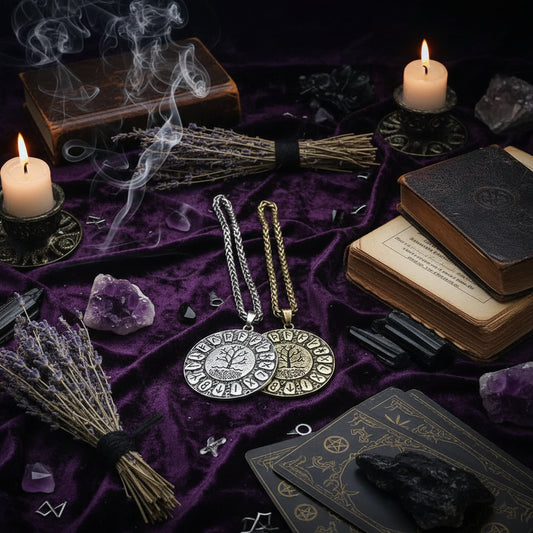
Altar Supplies: Dark autumnal colours, root vegetables, spirit/ancestor photographs, and black or purple candles. (Internal Link: Shop our Shadow Work and Divination Tools)
Yule (Winter Solstice)
The return of light. The Goddess gives birth to the Sun Child (the reincarnated God). The magical focus is on Hope, Peace, Setting intentions for the coming year, and bringing warmth into the home.
Altar Supplies: Evergreens (pine, cedar), wreaths, gold or silver candles, bells, and representations of the sun. (Internal Link: Shop our Yule Intention Candles)
Beltane (1 May)
The Great Rite, the union of the God and Goddess. The earth is fertile and bursting with life. The magical focus is on Fertility (literal or creative), Passion, Abundance, and Handfasting (sacred commitment).
Altar Supplies: Fresh spring flowers, hawthorn, green and red ribbons, beeswax candles, and a Maypole representation.
Lammas (1 August)
The sacrifice. The God sacrifices himself as the first grain harvest to sustain the people through the winter. The magical focus is on Gratitude, Reflection, Financial planning, and Honouring the sacrifices made to achieve your goals.
Altar Supplies: Loaves of bread (especially homemade), corn dollies, sheaves of wheat, and orange or yellow candles.
Simple Rituals to Honour the Wheel
You don't need complex ceremonies. Integrating the Sabbats into your daily life is the most powerful magic.
Seasonal Cleansing and Decorating
Change your altar cloth and decorations to reflect the current Sabbat's colours and energy. Use corresponding incense (e.g., Pine for Yule, Rose for Beltane). This keeps your sacred space energetically aligned with the Earth, making your work easier.
Feasting with Intention
Prepare a meal using seasonal ingredients appropriate for the Sabbat. For Mabon, bake an apple pie and mentally list three things you are grateful for with every bite. This grounds your magic through the food you consume, linking nourishment to ritual.
Magical Planning
Use the energy of the Sabbat to guide your long,term goals. Plan and plant the seeds of a new project at Ostara. Celebrate its achievement at Litha. Review and reflect on its failures at Samhain. Your life becomes a structured flow of intention and completion, maximizing magical efficiency.
Conclusion: The Eternal Cycle of Power
The Wheel of the Year is more than dates on a calendar, it is a living map of transformation. By consciously engaging with the Sabbats, you deepen your understanding of the Divine cycles and, most importantly, your own inherent power.
To truly master the craft, you must master the rhythm.
-
Shop Now: Explore our Seasonal Sabbat Kits which contain specific candles, herbs, and oils for each of the 8 festivals, making it easy to align your practice. (Internal Link: Link directly to the Sabbat Kits collection)
-
Continue the Path: You have the calendar, now learn the foundational spiritual system. Read our next guide: The Divine Polarity: Understanding the God and Goddess in Wicca.