Most witchcraft content online answers the question you asked by first making you read the question you didn’t ask. This guide does the opposite. Every section below opens with a one-sentence direct answer, then gives you the actual depth and nuance underneath it. If you only need the short answer, you have it in the first line. If you want to understand why that answer is true, keep reading.
This is a living reference, not a story. Jump to whatever you need using the index below, or read straight through for the complete picture of how serious supplies actually function in practice.
Jump to a Question
- Why do you have to cleanse crystals before use?
- Why is sage considered the best herb for warding?
- How do you do spellcraft the right way?
- What is the difference between cleansing and charging?
- Why do crystals seem to pick you instead of the other way around?
- Why does candle colour actually matter in spellwork?
- Why do witches time spells to moon phases?
- Why do you have to forget a sigil after charging it?
- What is the difference between protection and banishing magic?
- What do you actually need on an altar to start?
- Why did my spell not work?
- Do you need special tools to practice witchcraft?
- Why do witches ground before every working?
- Why is salt used to create protective boundaries?
- What are correspondences and why do they matter?
Why do you have to cleanse crystals before use?
Crystals absorb and hold energetic information from everyone who has touched them, including miners, handlers, shippers, and shop staff, and cleansing clears that accumulated information before you imprint your own intention onto the stone.
This is not superstition layered onto a mineral. Crystals are physically structured in repeating lattice patterns that respond measurably to vibration, temperature, and electromagnetic fields, which is precisely why quartz is used in watches and oscillators. Whether or not you accept the metaphysical framework, the practical case for cleansing is straightforward: a crystal that has passed through a dozen pairs of hands before reaching yours has been present for arguments, illness, exhaustion, and who knows what else, and you do not want to build a working on top of someone else’s unprocessed static.
The most reliable cleansing methods, in order of how broadly they work across crystal types: moonlight (safe for nearly everything, leave overnight on a windowsill), smoke from sage or palo santo, sound from a singing bowl or bell, and burial in dry rice or salt for a few hours (avoid this with soft or porous stones). Running water and direct sunlight work for many stones but will fade or fracture certain types, including amethyst, citrine, selenite, and anything with iron content, so check before you soak or sun a stone you don’t want to lose.
Cleanse a new crystal before its first use, and again whenever it feels dull, heavy, or simply less alive in the hand than it did when you first connected with it. There is no fixed schedule. The stone will tell you when it needs clearing if you are paying attention.
Shop CrystalsWhy is sage considered the best herb for warding?
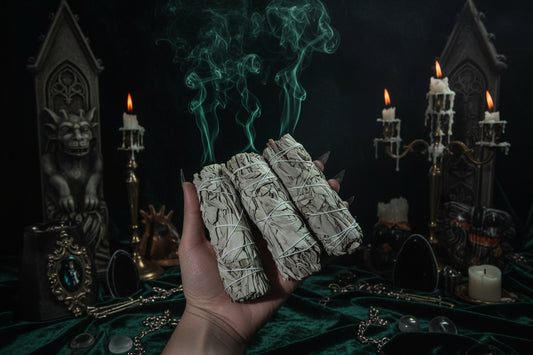
White sage combines a documented antimicrobial effect with one of the longest continuous ceremonial usage histories of any plant used in protective magic, giving it both a measurable physical action and an exceptionally strong accumulated energetic association.
The biochemical case is real and testable: burning white sage has been shown in laboratory conditions to reduce airborne bacterial counts in a room by as much as 94%, an effect that lingers for up to 24 hours after burning. That is not a metaphysical claim, it is closer to what an air purifier does, and it means that smoke cleansing with sage clears a space in a literal as well as energetic sense simultaneously.
The energetic case rests on consistency of association. Sage has been used ceremonially by Indigenous peoples of the Americas for protective and purifying purposes for thousands of years, and that depth of consistent use across generations builds an association that is, in practical terms, harder to displace than a freshly assigned correspondence. Other warding herbs (rosemary, wormwood, juniper) are excellent and in some cases more specific to a given purpose, but sage’s combination of broad protective association plus measurable air-clearing action is why it tends to outperform alternatives as a default warding tool, particularly for beginners who need a method that works even if their technique is still developing.
One important note on sourcing: demand for white sage has driven significant over-harvesting of wild populations in recent years. Palo santo and cultivated (rather than wild-harvested) sage are both responsible alternatives that retain most of the protective and clearing function.
Shop Sage and SmudgeHow do you do spellcraft the right way?
There is no single right way, but every spell that actually works contains the same three layers in the same order: clear intention, focused energy, and a deliberate release, and most spells that fail are missing or rushing one of these three.
Layer one: clear intention. Before anything else, the goal must be specific, present-tense, and entirely yours to control. “I want more money” is vague. “I am open to and actively pursuing new income opportunities” is workable. “I want my ex to come back” asks you to control another person’s will, which both fails reliably and raises real ethical concerns. The intention should describe a state you are moving into, framed around your own actions and openness rather than someone else’s behaviour.
Layer two: focused energy. This is where tools earn their place. Candles, crystals, herbs, and words are not the magic itself, they are the vehicle that holds your concentrated attention long enough to do something with it. The actual mechanism is your own sustained, undistracted focus directed at the outcome. A five-minute spell performed with total presence outperforms a forty-minute spell performed while half-thinking about your phone.
Layer three: deliberate release. The working has to end. You speak a closing line, snuff the candle, bury the herbs, whatever the form calls for, and then you stop thinking about it. This is the step beginners skip most often, and it is arguably the most important one. Continuing to obsessively monitor or re-do a spell tells your own mind that the first attempt did not work, which becomes a self-fulfilling expectation. Release is not indifference. It is trust that the working has been set into motion and now needs space to unfold.
Beyond these three layers, the "right way" is genuinely personal: some practitioners need elaborate ritual structure to access focus, others need almost none. The structure serves the focus, not the other way around.
Shop Spell Kits and SetsWhat is the difference between cleansing and charging?
Cleansing removes existing energetic residue from a tool, while charging deliberately loads that now-clear tool with a specific intention, and skipping cleansing before charging is the single most common reason a tool feels inconsistent in practice.
Think of it the way you would think of a whiteboard. Cleansing erases what was previously written on it. Charging is the act of writing something new and specific. If you charge a crystal without cleansing it first, you are writing your new intention over the top of old, unrelated information, and the result is a tool that holds a confused, layered signal rather than a clean one. This is why a crystal that "used to work great" sometimes stops feeling effective: it has accumulated layers of charge from multiple unrelated workings without ever being cleared between them.
The charging process itself is simple once the tool is clean: hold it, state your intention aloud or internally with full attention, and visualise that intention as already accomplished while maintaining physical contact with the object for at least a minute or two. Moonlight, sunlight (for the stones that tolerate it), and proximity to a lit candle all amplify the charging process but the core mechanism is your own directed attention.
Shop CrystalsWhy do crystals seem to pick you instead of the other way around?
The "crystal picks you" feeling is the result of genuine sensory and intuitive processing happening faster than conscious reasoning, not evidence of the crystal exerting independent will, though the outcome is identical either way: trust the pull.
Humans process an enormous amount of sensory information below the threshold of conscious awareness, including subtle visual cues like exact colour saturation, surface texture, and even the way light catches inclusions inside a stone. When you feel inexplicably drawn to one piece on a shelf of otherwise similar stones, your nervous system has likely already processed details your conscious mind has not caught up to yet. Whether you frame that as the stone’s energy calling to you or your own intuition reading information faster than logic, the practical instruction is the same: when a specific stone produces a genuine, unprompted pull, that response is worth listening to over a stone chosen purely by reading a correspondence list.
This is also why browsing crystals in person or through detailed photos, rather than buying blind from a generic description, tends to produce a stronger working relationship with the stone once it arrives.
Browse CrystalsWhy does candle colour actually matter in spellwork?
Candle colour matters because colour is processed by the brain faster and more automatically than language, which means a correctly chosen colour primes the nervous system into the appropriate emotional and energetic state before a single word of the spell is spoken.
This is measurable psychology, not just folklore. Colour perception triggers physiological responses (red measurably raises alertness and heart rate in controlled studies; blue tends to lower both) before the viewer has consciously identified what they are looking at. Black has carried a consistent cross-cultural association with banishing, absorption, and protection for centuries, which means lighting a black candle for a banishing working is not arbitrary, it is using a signal your own mind already deeply recognises to drop into the correct state faster.
The standard correspondences: black for banishing and protection, white for clarity and as a universal substitute for any colour you don’t have, red for passion and courage, green for abundance and growth, pink for love and self-compassion, gold or yellow for success and solar energy, blue for healing and calm, purple for psychic work and spiritual connection. If you only own one candle, white covers every purpose adequately. The colour amplifies and signals the working; it does not replace the intention behind it.
Shop Ritual CandlesWhy do witches time spells to moon phases?
Moon phase timing aligns the type of spell with a 29.5-day cycle of growth and release that the practice has used as an organisational framework for centuries, giving practitioners a consistent external rhythm to plan and pace their workings around rather than acting on impulse alone.
The waxing moon (new moon to full) is used for spells of growth, attraction, and building: love, abundance, new projects, healing that needs to increase. The full moon itself is the peak of power, used for charging tools, major manifestation work, and anything that benefits from maximum energetic amplification. The waning moon (full back to new) is used for release, banishing, and letting go: cutting cords, ending habits, clearing what no longer serves. The dark or new moon is for rest, deep introspection, and setting fresh intentions before the cycle begins again.
Whether lunar gravity has a direct causal effect on magical outcomes is genuinely unproven and frankly beside the point for most practitioners. What the lunar framework reliably provides is structure: a natural, repeating checkpoint system that prevents magical practice from becoming either constant frantic activity or total neglect. Practitioners who track their workings against the moon consistently report a stronger sense of rhythm and follow-through than those who work entirely without a timing framework.
Shop Moon Magic ToolsWhy do you have to forget a sigil after charging it?
Forgetting a sigil after charging transfers the working from your conscious, analytical mind to your unconscious mind, which is where chaos magic theory holds that the actual transformative work happens without the interference of doubt, anxiety, or constant monitoring.
This is the single most counterintuitive instruction in sigil practice and also the most consistently emphasised one across every serious source on the technique, from Austin Osman Spare onward. The logic runs like this: your conscious mind is excellent at analysis and terrible at trusting a process it cannot verify in real time. If you create a sigil and then keep checking on it, worrying about whether it’s working, or re-reading your written intention, you keep the request lodged in the anxious, doubting conscious mind rather than letting it sink into the unconscious, where chaos magic theory holds that genuine pattern-recognition and behavioural shift actually occur.
Practical methods for genuinely forgetting: burn the sigil immediately after charging so there is nothing left to look at, bury it, give it to someone else without explanation, or create it in a deliberately altered state (gazing technique, post-orgasm, exhaustion) specifically because that state makes the symbol harder for the conscious mind to fully encode and recall. The point is not pretending to forget while secretly remembering. Genuine release is the mechanism.
Read the Full Sigil Magic GuideWhat is the difference between protection and banishing magic?
Protection magic builds a defensive barrier that prevents harmful energy from entering in the first place, while banishing magic actively removes something that is already present, and using the wrong one for your situation is a common reason a working feels like it isn’t holding.
Protection is preventative and ongoing. A black tourmaline kept by your front door, a warded threshold, a protective sachet carried daily: these maintain a standing barrier against future intrusion. Protection magic does not require an existing problem to be worth doing, and in fact works best as a consistent baseline practice rather than a reaction to crisis.
Banishing is active and targeted. It assumes something specific is already present, energetically or otherwise, and the working is designed to push it out and close the door behind it. Banishing typically uses stronger, more assertive correspondences (black candles, wormwood, the waning moon) and a clear statement of what is being removed.
The two work best in sequence: banish first to clear what is already present, then establish protection to prevent recurrence. Skipping straight to protection while something hostile is still active is a bit like locking the door after leaving the original problem inside with you.
Shop Protection and WardingWhat do you actually need on an altar to start?
Nothing is strictly required to begin, but a genuinely useful starter altar covers four functions: a representation of intention or spirit, a tool for cleansing, a tool for focus, and a surface to work on, which can all be achieved with as few as three or four objects.
A minimal but complete starting altar: a candle (covers fire and serves most spell purposes), a small bowl of water or salt (covers cleansing and the water element), one crystal that you were genuinely drawn to rather than chosen for correspondence (covers focus and earth), and any flat surface, a shelf, a windowsill, the top of a dresser. That is a fully functional altar. Everything beyond this (an athame, a chalice, a cauldron, an altar cloth) adds depth and specificity but is genuinely optional for someone starting out.
The most common mistake new practitioners make with altar building is buying everything at once based on an aesthetic rather than acquiring tools as specific workings call for them. An altar that grows alongside your actual practice, one meaningful addition at a time, ends up far more personally charged than one assembled in a single shopping trip.
Shop Altar SuppliesWhy did my spell not work?
The most common reasons a spell appears not to work are a vague or contradictory intention, working against your own genuine unconscious belief, asking for something outside your control, not giving the working time to unfold, or continuing to anxiously monitor it after release.
Before assuming a technique failed, check these in order. Was the intention specific? "I want things to get better" gives the working nothing concrete to act on. Did you secretly doubt it would work? A part of you that genuinely believes the opposite of your stated intention will consistently undermine the working; this is the single most underestimated factor in spell failure. Were you asking to control something outside your influence, particularly another person’s feelings or choices? These workings are both ethically questionable and practically unreliable, since you cannot genuinely command another person’s will. Did you give it time? Most manifestation and abundance work unfolds over weeks to months, not hours; expecting overnight results sets up a false sense of failure. Did you keep checking on it? As covered above, continued anxious monitoring re-anchors the request in doubt rather than letting it move into the deeper unconscious processing that actually drives change.
If you have genuinely ruled out all five and the working still seems inert, it may simply be that the specific method did not suit you. Not every technique resonates with every practitioner; trying a different tool (sigil instead of candle, herb sachet instead of crystal) for the same intention is a reasonable next step.
Shop Spell KitsDo you need special tools to practice witchcraft?
No tool is strictly required to practice witchcraft, because the actual mechanism of magic is focused intention and will, but tools are not decorative either, they function as physical anchors that make sustained focus significantly easier to achieve and maintain.
This is one of the most consistently agreed-upon points across witchcraft traditions: your mind is the primary tool, and a witch stranded with absolutely nothing can still ground, visualise, and direct intention effectively. However, dismissing tools as unnecessary misunderstands what they actually do. A candle gives your eyes something to focus on while your mind holds an intention. A crystal gives your hands something to hold while you concentrate, anchoring your attention in the body rather than letting it drift. Specific herbs and colours carry centuries of accumulated association that prime your own mind into the right state faster than starting from nothing.
The honest answer: tools are not required, but for the vast majority of practitioners, especially beginners who have not yet built the internal discipline to sustain unaided focus, they make the difference between a working that actually lands and one that fades into a vague wish. Start without judgment about whether you "should" need tools. Use what genuinely helps you focus.
Shop Beginner KitsWhy do witches ground before every working?
Grounding settles a scattered, anxious, or overstimulated nervous system into a stable baseline before magical work begins, and skipping it means building a working on top of whatever chaotic mental state you walked in with, which tends to produce equally chaotic results.
Grounding is not a spiritual flourish tacked onto the start of a ritual. It is the practical equivalent of taking a breath before lifting something heavy. A simple, effective grounding practice: sit or stand with both feet flat on the floor, take five slow breaths with a longer exhale than inhale, and either visualise roots extending from your feet into the earth or simply notice, in detail, five things you can physically feel right now (the chair, your clothing, the air temperature). This takes under two minutes and produces a measurably calmer, more focused state in which to actually do the work.
Practitioners who skip grounding most often report spells that feel "off," scattered, or hard to commit to fully. The intention may have been fine; the state it was cast from was not stable enough to hold it cleanly.
Shop Grounding ToolsWhy is salt used to create protective boundaries?
Salt has been used as a protective and purifying boundary marker across an unusually wide range of unrelated cultures and historical periods, a level of cross-cultural consensus that is rare for any single magical correspondence and stems partly from salt’s genuine physical role as a preservative that halts decay.
Salt prevents organic decomposition, a real, observable, physical property that long predates any magical use of the substance. That physical fact (salt stops things from rotting or being consumed) maps directly onto its symbolic role: a line of salt is understood to stop something hostile or decaying from crossing, the same way it stops bacteria from breaking down food. This is one of the cleanest examples in witchcraft practice of a physical property and a symbolic correspondence reinforcing each other rather than existing separately.
Practically, a salt boundary is created by pouring a continuous, unbroken line of salt across a threshold or fully around a space, with the clear stated intention that nothing harmful may cross it. It is commonly used at doorways, windowsills, and around a ritual circle for the duration of a working, then swept up and disposed of afterward rather than left indefinitely, since a stale, long-undisturbed boundary loses the freshness of its original charge.
Shop Protection ToolsWhat are correspondences and why do they matter?
Correspondences are the accumulated, centuries-deep associations between specific objects, colours, days, and planets and specific magical purposes, and they matter because they let a practitioner build a coherent working quickly using a shared symbolic language rather than inventing meaning from scratch every time.
A correspondence is essentially a shortcut built from a very long chain of historical use: rose for love because it has been associated with Venus and the heart across multiple cultures for millennia, Thursday for abundance because it is ruled by Jupiter, the planet of expansion, citrine for prosperity because its colour and clarity have been linked to wealth and sunlight consistently across traditions. None of these associations were arbitrarily assigned yesterday; they carry weight precisely because so many practitioners across so much time have reinforced the same link.
For a beginner, the practical use of correspondence tables (which pair herbs, crystals, colours, days, and planets with specific intentions) is speed and confidence: rather than guessing which tool fits which purpose, you have a tested starting framework. As experience grows, most practitioners begin noticing their own personal correspondences (a stone that consistently feels protective to them regardless of its traditional association) and the wise approach is to use the traditional table as a foundation while trusting personal experience when it diverges. The table is a guide, not a law.
Shop Herbs and BotanicalsQuick Reference: Every Answer at a Glance
| Question | One-Line Answer | Shop |
|---|---|---|
| Why cleanse crystals? | Clears accumulated energy from prior handlers before you imprint your own intention | View |
| Why is sage best for warding? | Documented antimicrobial action plus the deepest cross-cultural protective association of any common herb | View |
| How to do spellcraft right? | Clear intention, focused energy, deliberate release, in that order, every time | View |
| Cleanse vs charge? | Cleanse erases prior energy, charge deliberately writes new intention onto a now-clear tool | View |
| Why does candle colour matter? | Colour primes the nervous system into the right state faster than language alone | View |
| Why time spells to the moon? | Gives a consistent external rhythm for growth versus release work | View |
| Why forget a charged sigil? | Moves the working from the doubting conscious mind into the unconscious where change actually happens | View |
| Protection vs banishing? | Protection prevents future intrusion, banishing actively removes what is already present | View |
| Why ground first? | Settles a scattered nervous system so the working isn’t built on chaos | View |
| Why does salt protect? | Mirrors its real physical role as a preservative that halts decay and intrusion | View |
Still Have a Question Not Covered Here
This guide covers the fifteen questions practitioners search for most consistently, but witchcraft practice raises new specific questions constantly. Our full blog covers deep dives into sigil magic, specific crystal properties, herbal correspondences, and the foundations of pagan practice in far more depth than a single FAQ page allows.
The Clean Slate
A Complete Cleanse, Charge and Release Working for Any New Tool
This ritual exists specifically to demonstrate the three-layer structure covered in this guide using any single new tool, whether that is a crystal, a candle, or a herb sachet. Once you can feel the difference between cleansing, charging, and release in your body, every other working in your practice becomes more precise.
-
Ground first. Sit with both feet flat on the floor. Take five slow breaths, exhaling longer than you inhale. Notice five things you can physically feel right now. This is not preamble, it is the actual first step.
-
Cleanse the tool. Pass it through sage or palo santo smoke, or pass it briefly through the salt or water, speaking clearly: "Whatever this tool has carried before now is cleared. It comes to me clean."
-
Pause and notice. Hold the cleansed tool and simply notice how it feels in your hand without adding anything yet. This pause matters: it is the moment between erasing and writing.
-
State one specific intention. Not a vague hope. One sentence, present tense, about something within your own control. Speak it aloud while holding the tool with full attention.
-
Charge for two full minutes. Keep physical contact with the tool. Visualise the intention as already true. Do not let your mind wander to logistics or doubt; if it does, simply return to the visualisation without frustration.
-
Release deliberately. Speak a clear closing line: "This working is set. I release it now and trust it to unfold." Then physically put the tool down, change your posture, and do something unrelated immediately afterward, a glass of water, opening a window, anything that marks a clear transition out of the working.
Do not check on the tool, re-do the charging, or revisit the intention for at least 48 hours. This enforced gap is the release layer in practice, not just in theory.
Every Answer Above Has a Tool Behind It
Quality crystals, ethically sourced herbs, ritual candles, and complete spell kits, all available now with free shipping over $35 across Australia and the US. AfterPay and PayPal at checkout.